
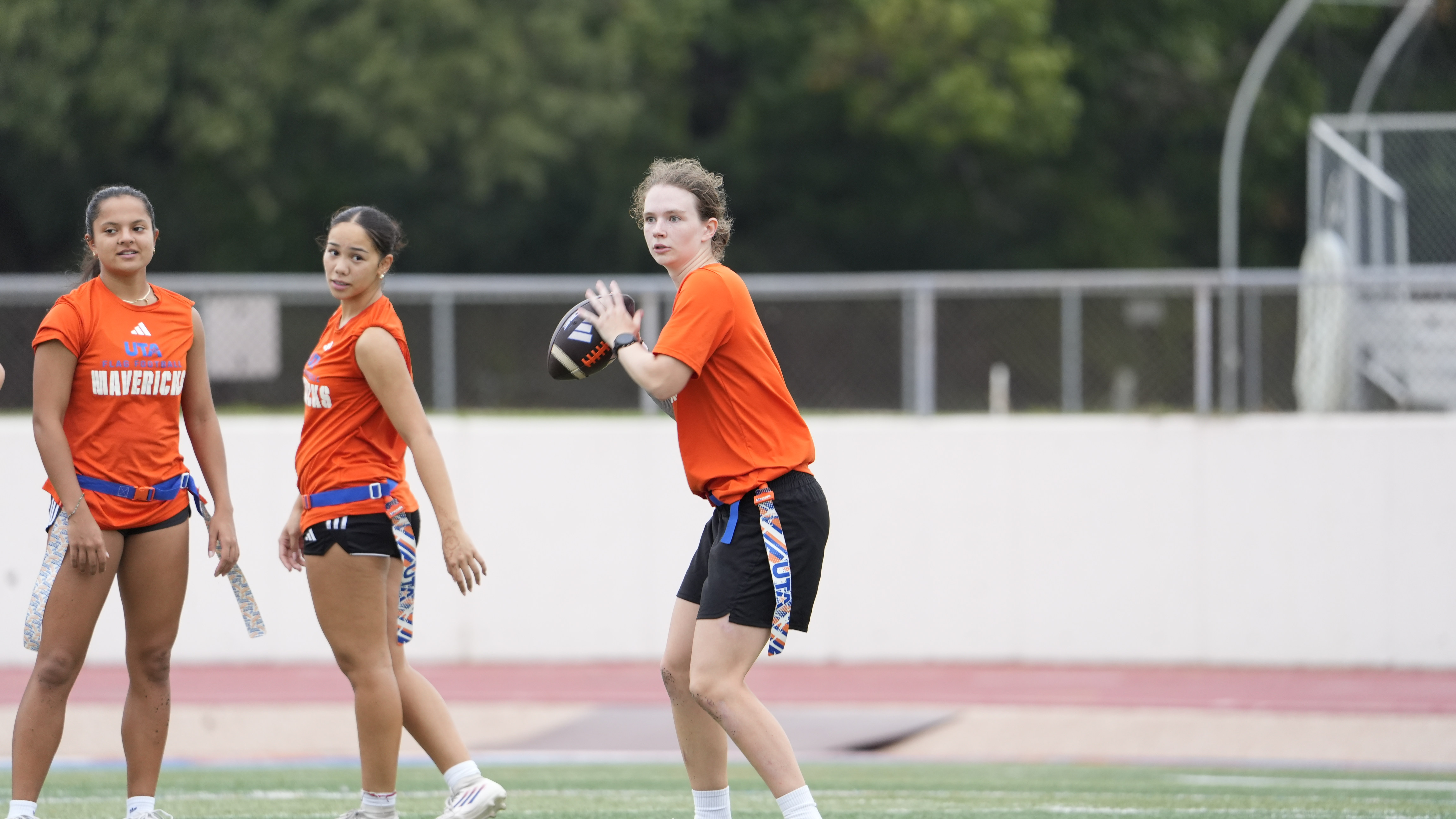
Australian women are beginning to carve out a new route into US college football, and national team quarterback Tessa Davis and wide receiver Amelie Prosser-Shaw are at the front of it. The pair are preparing to join the University of Texas at Arlington after becoming the first Australians to earn NCAA Division I flag football scholarships. UTA will begin varsity competition in spring 2027, becoming the first Division I university in Texas to field women’s flag football.
For Davis and Prosser-Shaw, the move represents a major personal opportunity. For Australian flag football, it could signal something broader: the emergence of US college flag football as a genuine pathway for elite Australian women. Their recruitment also shows how quickly that opportunity is changing. UTA coach Melinda Nguyen did not first see them at an American showcase or through a traditional US recruiting pipeline. She saw them representing Australia at the IFAF Asia-Oceania Continental Championship in Ningbo, China.
As the tournament progressed, Nguyen was struck by the way the Australian team continued to improve. “I knew they were a relatively young team with limited experience in flag football, but you wouldn’t have known it by watching them play,” Nguyen said. Davis and Prosser-Shaw stood out together. “The chemistry between Tessa and Amelie really stood out to me,” she said.
Davis impressed with her ability to throw the football under pressure, while Prosser-Shaw brought an intensity and ball skills that caught Nguyen’s attention. “Tessa in particular had a really good feel for throwing the football and making some impressive throws under pressure,” she said. “With Amelie, her ability to high-point the football really stood out to me. That is a skill that can be difficult to teach.” Just as important was what Nguyen saw beyond technique. Their competitiveness, athleticism and willingness to keep developing throughout the tournament fitted the type of player UTA wanted as it built a new program.
The timing is changing
The opportunity is emerging at a significant moment for the sport. Women’s flag football entered the NCAA’s Emerging Sports for Women program in 2026, while flag football will make its Olympic debut at Los Angeles 2028. In May, the NCAA said more than 100 schools were planning to compete during the next academic year, up from around 60 programs in spring 2026. American Football Australia chief executive Wade Kelly believes that growth creates an unusual window for Australian athletes.
Asked about the biggest opportunity for Australian women, Kelly’s answer was simple: “Timing.” A growing college system offers the possibility of scholarships, daily training at a high level and regular competition in an environment where women’s flag football is expanding rapidly.
AFA does not view that as a rival to the Australian system. Kelly described the US college route as “complementary, not competitive”, with Australian development continuing through schools, clubs, state leagues, national championships, the Australian Premier Flag League and national team programs. The American college game adds another option. Some athletes will continue to develop primarily at home. Others may spend several years inside US programs. Both can ultimately feed back into the Australian national team.
What makes Nguyen’s perspective particularly significant is that she is already looking beyond individual recruits. “We are definitely looking internationally as we continue to build the program,” she said. “I think there is a lot of untapped talent outside of the traditional American football pipeline.” Australia, she believes, could become part of that search. “Australia is a market that I think could become very meaningful for us.”
Nguyen pointed to the athletic qualities, competitiveness and development potential she saw in China. “I think there are athletes in Australia who may not have had the same opportunities or exposure to the collegiate game that athletes in the U.S. have had,” she said. “For us, it’s about identifying athletes who have the right athletic qualities, competitiveness, and mindset to develop within our system.”
Why Australian sporting backgrounds translate to flag football
Davis and Prosser-Shaw illustrate that point. Davis, from Adelaide’s Immanuel College, has been part of the Australian national program since 2024 and helped Australia win silver at the 2025 Asia-Oceania Continental Championships. Before establishing herself at quarterback, she also competed at junior national championships in Australian rules football and cricket.
Prosser-Shaw came to flag football through a similarly broad sporting background, including Australian rules football, athletics and cross country. She won three consecutive Sydney AFL premierships before flag football became a serious part of her sporting life. Writing for UTA’s 817 Made, Prosser-Shaw described just how quickly that transition had occurred: “It is exciting to think that a sport I only discovered 18 months ago has already provided me with the opportunity to play at a D1 college and pursue my dream of becoming an Olympian.”
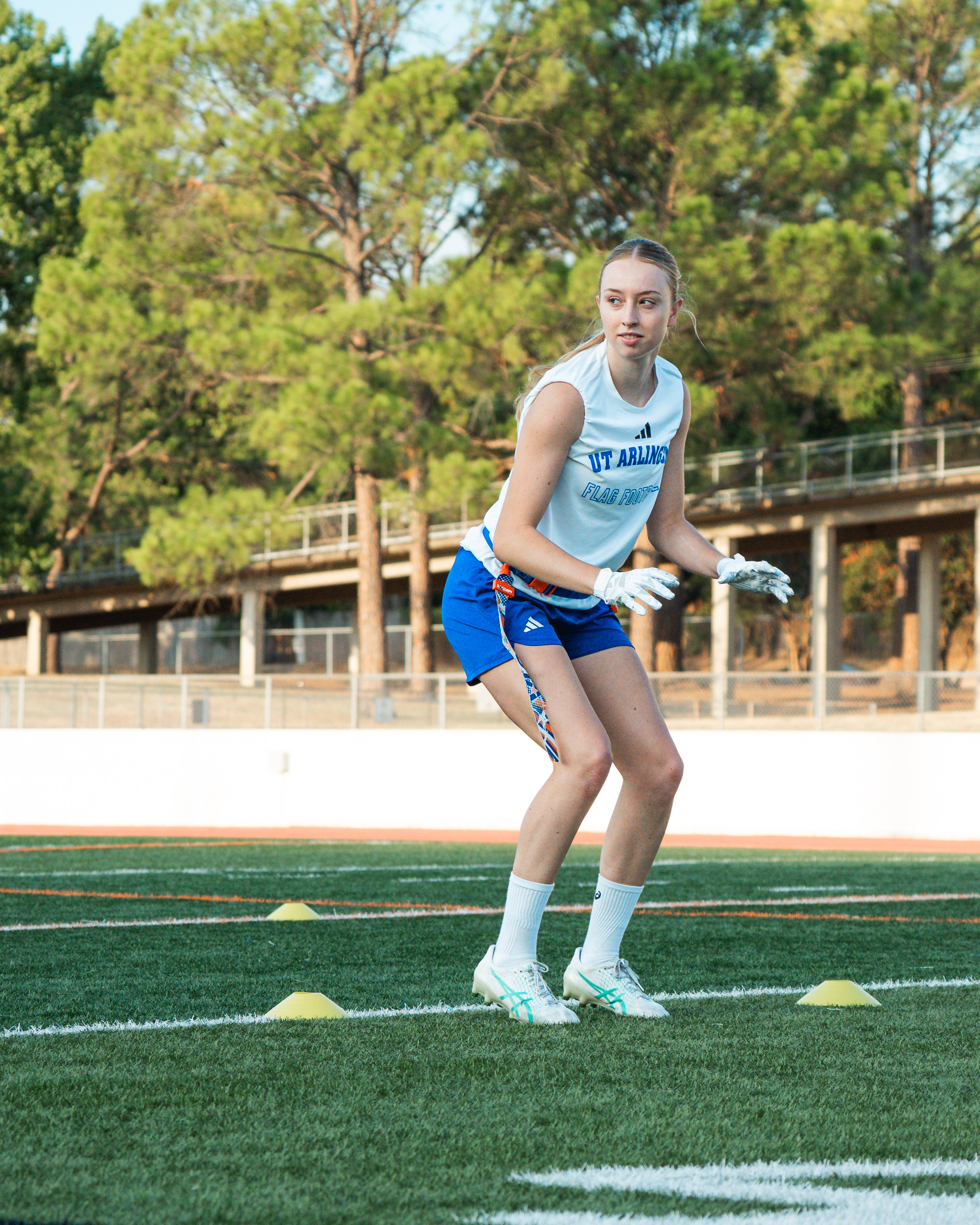
UTA recruited Prosser-Shaw as a wide receiver and Davis at quarterback. Both were also selected for Australia’s squad for the 2026 IFAF World Flag Football Championships in Düsseldorf. Their backgrounds reflect one of the potential advantages Australian athletes bring. Many arrive in flag football after developing movement skills, spatial awareness and competitiveness in sports such as touch football, rugby, netball, athletics, cricket and Australian rules football.
Where Australian flag football still needs to develop
The challenge for Australia is not simply producing talented athletes. It is giving them enough football. American players are increasingly gaining access to organised flag football from a young age and can arrive at college with years of repetitions behind them. Australia is still developing that depth.
Kelly identified football IQ as one of the major areas for growth, particularly the volume of game time and repetitions American athletes accumulate before reaching college. That matters because athleticism alone is not enough. Quarterbacks and receivers need timing, reads and route detail. Defenders need recognition, spacing and anticipation. All of them need the ability to process the game quickly.
A player who develops in Australia, earns a US scholarship and then spends several seasons receiving daily coaching and regular competition could eventually return to the national program with experience that remains difficult to replicate domestically. But Nguyen says an international player must also be prepared for the demands away from the field.
Her description of the mentality required is straightforward: “They have to be comfortable being uncomfortable.” An international athlete entering a Division I program is not simply adjusting to a higher standard of football. They are moving countries, adapting to a different culture, living away from family and established support networks and beginning university life while being expected to compete.
“The training is intensive, the expectations are high,” Nguyen said. “You have to be willing to be uncomfortable, make mistakes, ask questions, learn quickly, and keep pushing yourself. You don’t have to come in knowing everything. What I want to see is an athlete who is used to challenging themselves and who genuinely wants to see how good they can become.”
AFA makes the same point from the Australian side. More American programs do not mean scholarships will simply be handed to Australian players. Athletes still need to perform, make themselves visible and convince coaches they belong at that level. Kelly was blunt on that point: “It’s not a given; everything is earned.”
More than two scholarships
If Davis and Prosser-Shaw are followed by more Australians, the importance of the US college game could extend well beyond individual scholarship opportunities. It could become part of Australia’s elite development system. That is particularly relevant with LA28 approaching. Australia is building towards an Olympic cycle at the same time the American college game is expanding.
AFA has been developing talent identification, national camps, state pathways and elite development support while also trying to increase international competition. Kelly sees the college system as an additional layer within that work rather than a shortcut around it. Davis and Prosser-Shaw matter because they provide an early example of how the pieces might connect.
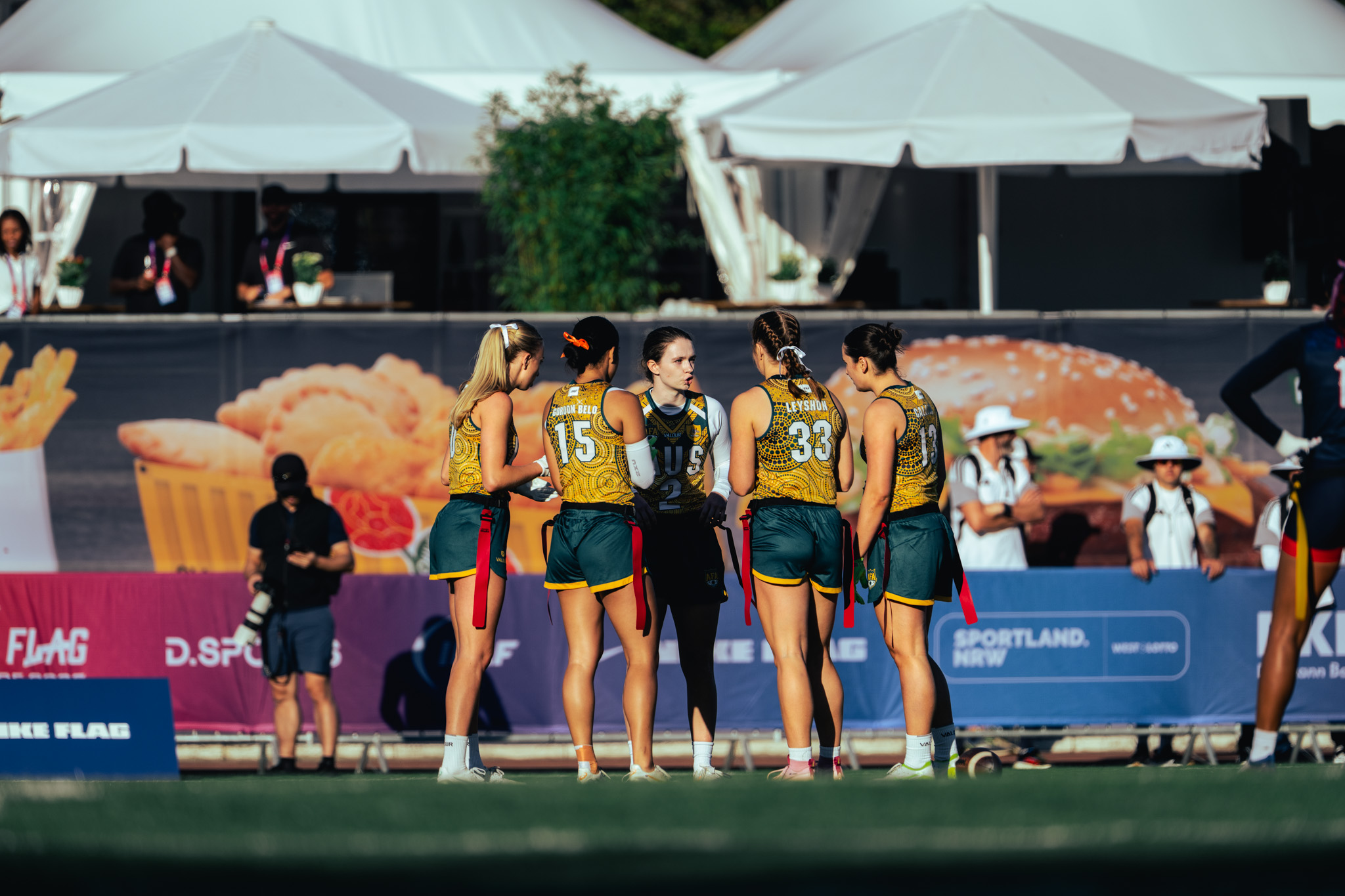
If Australian quarterbacks, receivers, centres, rushers and defensive backs begin regularly entering US programs, they could return with greater football knowledge, more competitive experience and years of elite coaching. Some may eventually come home as coaches and leaders themselves.
Prosser-Shaw has already spoken about that possibility. Writing for 817 Made, she said she hoped to use her experience in Australian and American football environments to help “bridge the gap” between emerging international programs and established collegiate systems. That exchange could eventually become as important as the scholarships themselves.
LA28 changes the stakes
There is also a participation question. For a young Australian girl discovering flag football at school, the sport can now point to opportunities that did not exist in the same form even a few years ago. Kelly believes athletes such as Davis, Prosser-Shaw and Australian representative Olivia Manfre can make those possibilities visible. Manfre helped pioneer that US college opportunity, moving to NAIA institution Southwestern College in Kansas in 2024, where she received a full-tuition scholarship and joined the flag football program. Davis and Prosser-Shaw are now extending that pathway into NCAA Division I.
“When a girl in a Sporting Schools program can see a genuine path to a US scholarship, and potentially to an Olympic Games, the sport becomes a real aspiration,” he said. For Prosser-Shaw, the Olympic ambition is explicit: “Representing Australia at LA28 is my ultimate goal.”
Nguyen sees the same significance from the college side. “I think the next few years are going to be incredibly significant for women entering flag football,” she said. “They aren’t just joining an established game — they are becoming part of the generation that is going to help shape what women’s flag football looks like at the collegiate, national, and international levels.”
That may be one of the defining features of the current moment. The athletes entering now are not simply competing for places within a mature sporting structure. They are helping establish the structure itself. They can play at college, represent their countries and pursue international opportunities while creating a clearer route for the athletes who follow them.
“We are still very early in this growth,” Nguyen said, “and that makes this a really special time to be a woman in flag football.”
The real test is what happens next
Two scholarships do not yet make a pipeline. UTA has not played its first varsity season. Los Angeles 2028 is still ahead. Australia remains a developing flag football nation, and the gap in experience between Australian and American athletes has not disappeared.
But something important has already happened. A Division I coach watched Australia compete internationally, identified two players whose skills could translate to the US college game and recruited them into a new program. That same coach now believes Australia could become a meaningful recruiting market.
That is a stronger sign of progress than the scholarships alone.
The next test is whether Davis and Prosser-Shaw are followed. If US coaches increasingly scout Australian athletes, if local players become easier for American programs to identify, and if those who earn opportunities return with greater football knowledge and experience, the relationship could begin to sustain itself.
Australian programs develop athletes. US colleges provide another environment in which some of them can improve. Those athletes strengthen Australian national teams and, potentially, the domestic game when they return. Then another generation can see a route that previously did not exist.
Davis and Prosser-Shaw may be the first Australians to take that step at Division I level. The significance of their move will ultimately be measured by how many are able to follow.